Abstract: This religious studies paper analyzes and rigorously deconstructs the phenomenon of semantic appropriation and the profound „cannibalization“ of the conceptual apparatus of ancient gnosis within modern esotericism, popular culture, and the New Age movement. Using a sample of ten key terms supported by verifiable primary texts from Nag Hammadi and an international scholarly apparatus, the work demonstrates the abysmal gap between the original cosmological, soteriological, and existentially stark function of these terms and their current commercially flattened, psychologized, or ufologized caricature. Simultaneously, the study demarcates the boundary between C. G. Jung’s legitimate psychological hermeneutics and the deliberate, fraudulent distortion of history by modern internet charlatans.

1. Introduction: The Semantic Hijacking of Ancient Terminology and Digital Noise
Modern esoteric and new religious movements systematically incorporate a lexicon that evokes antiquity, exclusivity, and mysterious authority in the public mind. Terms such as gnosis, Sophia, Pleroma, Archons, Demiurge, Monad, Pneuma, emanation, and divine spark heavily saturate the contemporary digital space (DeConick, 2016).
When these currents are confronted with the ancient sources themselves, a fundamental, irreconcilable historical conflict arises. If a modern author or internet guru uses a Gnostic term, religious studies analysis must rigorously distinguish whether they are building upon the historical context or weaponizing ancient nomenclature as a stolen marketing label for an entirely alien doctrine.
We live in an era of digital noise where social media algorithms on TikTok, Instagram, and YouTube demand the radical reduction of complex theology into catchy buzzwords. Intricate ontological systems are ground down into digestible shortcuts (parasites, dimensions, spark), which not only accelerates the cannibalization process but turns it into a mass business.
We define this phenomenon in religious studies as semantic appropriation (cannibalization): the old religious term is ripped from its Coptic and Greek context, its ontological content is surgically removed, and it is replaced with a modern equivalent. Most seriously, this mutated content is subsequently falsely presented as „the original secret teachings of the ancient Gnostics“ (Hanegraaff, 1996).

2. Origin and Metamorphosis: The Heresiological Model in Reverse
Historically speaking, today’s esotericism repeats the method of ancient Christian heresiologists, albeit with the opposite sign. While church fathers once ripped Gnostic statements out of context to disparage them, today’s New Age does the exact same thing—ripping them out and presenting them as „their own higher truth.“
Behind this process lies a deeply rooted psychological need to rid oneself of the fear of the ancient world’s radical foreignness. The ancient Gnostic did not believe in a „benevolent universe“; they lived with the awareness that the cosmos is the creation of a blind, tyrannical Demiurge and that humanity is an alien stranger within it, suffering from cosmic amnesia. Modern humans, however, cannot bear this terrifying foreignness. Thus, a psychologizing defense mechanism emerges: old myths are refashioned so that they „do not unpleasantly threaten extinction,“ but instead stroke the ego to support modern individualism and commercial spirituality.
This semantic parasite-authorization is closely linked to the myth of „silenced truth“ and conspiratorial thinking, which frequently borrows anti-governmental and anti-systemic rhetoric. However, it is necessary to set the record straight and avoid generalizations: Gnostics of the 21st century (or individuals sincerely studying Gnostic currents within democratic societies) are by nature neither anti-systemic nor anti-governmental. Rather, these radical system-conspiracy narratives are generated and exploited precisely by those authors who cannibalize Gnostic vocabulary in order to sell their own esoteric products by stoking fear of „secret forces controlling the world.“ In doing so, they conceal the fact that historical texts from Nag Hammadi were never concealed in a conspiratorial sense, but were properly scientifically published and translated. Conspiratorial rhetoric is necessary for charlatans because the myth of „forbidden secrets“ sells paid courses much better.
3. Case Studies and Verifiable Evidentiary Apparatus: Deconstructing the Gnostic Lexicon
Instead of comparative tables that fracture the argument, let us examine the direct clash between ancient reality and modern esoteric theft through specific cases.
3.1. Gnosis (γνῶσις)
- Historical Evidence: The Gospel of Truth (NHC I 16,31–17,4) explicitly links gnosis with soteriological salvation and the knowledge of the transcendent Father, whose ignorance is the cause of cosmic wandering and anxiety (Attridge & MacRae, 1985). This is not about accumulating information, but about an absolute revelation of divine origin.
- Modern Reinterpretation: Gnosis becomes a tool for personal development. The Gnostic Institute of Anthropology defines gnosis on its official website through „psychological, philosophical, and scientific practices“ leading to intimate „self-realization“ (intimate self-realisation) and the „awakening of consciousness“ (Gnostic Institute of Anthropology, n.d.).
- Available at: Gnostic Institute of Anthropology
- Verdict and Critical Impact: Here, the manipulative nature of the entire process is fully exposed. From a radical, existentially crushing path toward the metaphysical liberation of the soul from the prison of a blind creator, a content-free coaching concept for lazy seekers was forged. The public is deceived by being sold ordinary, commercially packaged self-development under the banner of „ancient gnosis.“
3.2. Sophia (σοφία)
- Historical Evidence: In texts such as The Apocryphon of John (NHC II 9–10), Sophia is not an abstract principle, but a specific personified entity of the divine drama („the wisdom of previous thought“), whose independent act of production without a partner’s consent leads to the birth of the imperfect creator Yaldabaoth and a dramatic shock to the pleroma (Waldstein & Wisse, 1995).
- Modern Reinterpretation: Degradation into a conflict-free „divine feminine energy“ (Divine Feminine). The podcast Goddess Witch Womb presents Sophia as „The Divine Feminine Archetype“ and „Mother of all Creation“ (The Goddess, The Witch & The Womb, n.d.). The Sophia Foundation describes her as the „Divine Mother of humanity“ (Sophia Foundation, n.d.), while Caitlin Matthews (2001) incorporates her into the New Age movement as a universal goddess principle.
- Available at: The Goddess, The Witch & The Womb Podcast | Sophia Foundation
- Verdict and Critical Impact: The tragic figure of the cosmic drama, whose fall triggered a structural upheaval of the divine pleroma, is ruthlessly castrated into a conflict-free gender stereotype. Authors of modern podcasts and women’s circles lie to their female listeners by presenting this novel ecological-divine mythology as an authentic legacy of Coptic texts, unaware that it has about as much in common with the real Sophia as a comic book character with an ancient god.
3.3. Archons (ἄρχοντες)
- Historical Evidence: The Hypostasis of the Archons (NHC II 86,20–97,23) describes blind, proud, and arrogant rulers of the forming material cosmos, led by Samael („the god of the blind“), who attempt to trap human light (Layton, 1987).
- Modern Reinterpretation: Ufology and parasitic ontology. Modern esoteric author Sarah Elkhaldy states on The Alchemist platform: „A more appropriate name for these forces would be ‚parasites'“ (Elkhaldy, n.d.). Internet communities shift the meaning of Archons toward energy vampires feeding on human fear (the loosh concept), frequently combined with Matrix and reptilian theories.
- Available at: The Alchemist Community
- Verdict and Critical Impact: Here occurs the most brutal rape of historical sources for the sake of generating clicks on social media. Content creators take serious theological-cosmological concepts of ancient dualism and mix them with cheap sci-fi ufology. They lie to their viewers and readers by claiming they are uncovering „secrets from Nag Hammadi about alien predators.“ In reality, they milk audience fear and build a business on an absolute fraud against historical sources.
3.4. Demiurge (δημιουργός)
- Historical Evidence: Gnostic systems adopted the older Platonic term (Timaeus) for the organizer of the cosmos and transformed it into a lower, ignorant creator (Yaldabaoth), a bounded power ruler in opposition to the transcendent God (The Apocryphon of John, NHC II 11,15–20; Meyer, 2007).
- Modern Reinterpretation: Reduction to the human ego. The aforementioned platform The Alchemist explicitly claims: „The Demiurge is us, our Ego“ (Elkhaldy, n.d.). Other esoteric sources designate it as „the fallen ego of the Logos“ (School of Gnostics, n.d.). Pop culture and films like Matrix adopt this motif as the tyrannical architect of a simulation, entirely severing the original Coptic theological context.
- Available at: School of Gnostics
- Verdict and Critical Impact: Misuse of psychological parallels to create a false scientific impression. Modern esotericists lie to their readers by substituting an objective cosmological entity outside the material world with an internal psychological problem. They do this to turn a religious system into a cheap psychological manual while abusing the authority of ancient texts to legitimize their own folk therapies.
3.5. Pneuma (πνεῦμα) and Monad (μονάς)
- Historical Evidence: While Pneuma represents spiritual essence or the breath animating humans in Sethian Gnostic texts, Monad is the philosophical concept of absolute Unity—the Invisible God, rooted in middle Platonism and hermetism (Turner, 2001).
- Modern Reinterpretation: Energetization and systematization. The web platform Uniform Gnosis synthesizes old terms and defines Pneuma as „a direct emanation of the Pleroma, a spark of the Monad itself“ (Uniform Gnosis, n.d.).
- Available at: Uniform Gnosis
- Verdict and Critical Impact: Assembling a „Frankenstein’s monster“ from unrelated concepts. Modern internet gurus rip terms out of various centuries and currents, melt them into a single esoteric stew, and falsely tell their followers that this is a „unified Gnostic teaching.“ In reality, they construct their own sectarian systems and steal identity from texts that would never have recognized such a syncretic hodgepodge.
3.6. Divine Spark
- Historical Evidence: This is a modern religious studies shorthand umbrella term for ancient Coptic and Greek concepts of spiritual seed (sperma) or light within a human who is otherwise cast into the darkness of ignorance without knowledge (DeConick, 2016).
- Modern Reinterpretation: Affirmative cliché. The platform School of Gnostics publishes a text titled The Divine Spark: What You Truly Are, claiming that within each person is „a fragment of genuine divine light“ (School of Gnostics, n.d.).
- Available at: School of Gnostics
- Verdict and Critical Impact: Extreme positivization and cynical betrayal of the ancient message. While the ancient Gnostic suffered deep anxiety over being trapped in an evil world and was lost without an external divine revelation, modern New Age trades in cheap optimism such as „you are a divine spark, everything is fine.“ These authors lie to people’s faces because they take texts filled with radical human distress and turn them into motivational candies to make a profit.

4. Special Case and Historical Correction: The Vindication of C. G. Jung
In critiquing modern appropriation, it is necessary to transparently separate and defend the work of Carl Gustav Jung. Jung does not belong to the New Age circle and did not cannibalize Gnostic vocabulary.
Jung’s historical role is crucial for Gnosticism. He was the one who actively advocated for acquiring the first codex from Nag Hammadi, which bears his name—the Jung Codex (Codex I, containing The Gospel of Truth)—to protect it from destruction and make it available to the scientific community (Robinson, 1988).
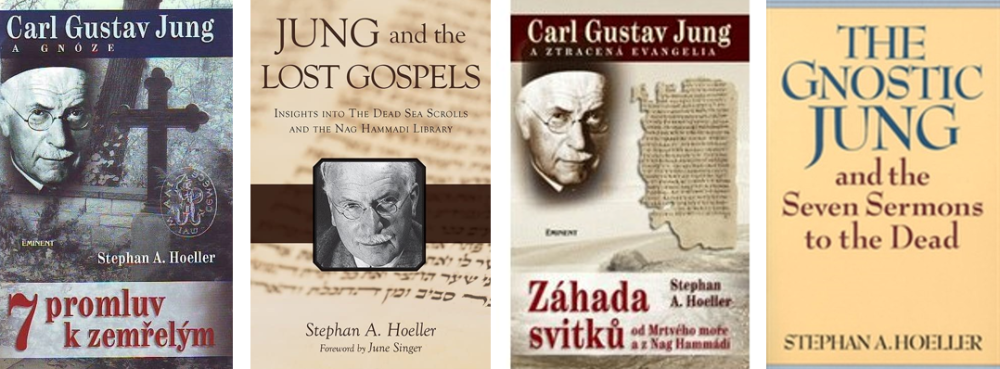
In his depth psychology, he did use Gnostic concepts (the Demiurge as a reflection of the ego, the Pleroma as a symbol of the Self), but he did so completely transparently (Hoeller, 1982). Jung created an acknowledged Jungian hermeneutic. He never denied Gnostic texts their original historical meaning, never tried to falsify them, nor claimed that they represented the historical dogmatics of ancient Gnostics. He granted himself the right to a psychological interpretation without damaging the textual integrity of the sources.
The Real Problem: Modern esoteric movements took Jung’s psychological interpretation, merged it with quantum mysticism and ufology, and began falsely proclaiming this mutated construct as „the original texts of Nag Hammadi.“ Cannibalism is therefore not Jung’s doing, but the work of those who lost historical and scientific respect for the sources.
5. Mechanisms of Cannibalization and the Economics of Gnostic Capitalism
Behind these reinterpretations lies not mere naivety, but a highly lucrative business model. This is Gnostic capitalism, which monetizes human spiritual distress through paid webinars, courses on „awakening your inner Sophia,“ and the sale of esoteric products. The primary mechanisms of this fraud include:
- Energetization and Ufology: Mythological and cosmological entities (Archons, Aeons) are translated into the banal language of energy parasites and extraterrestrials.
- De-soteriologization: The desperately serious question of soul salvation (gnosis) is reduced to commercial self-awareness and „manifesting abundance.“
- Pseudohistorical Syncretism: The construction of new movements linking Coptic texts with Hinduism, chakras, and pop-culture concepts of the Matrix.
Conclusion: An Open Letter to Readers Against Esoteric Lies
Modern esotericism builds its authority on false martyrdom and systematic lies: „The church suppressed the Gnostics, and we now bring you their true, hidden teachings.“
The reality is that contemporary esotericism does to the Nag Hammadi texts precisely what ancient Christian heresiologists once did—drastically distorts them for its own power and commercial purposes. They rip out attractive terms, empty them out, stuff them with modern psycho-energetic waste, and fraudulently label the result as original Gnosticism.
Why do these people do it? Because true historical Gnosticism is too complex, inconvenient, and requires deep study of sources. They lie to their listeners, readers, and viewers because abusing the ancient mystical attire is the easiest way to sell empty courses, esoteric books, and pseudoscientific delusions. Esoteric vandalism against culture and history destroys the critical thinking of the public.
The academic and religious studies community must not take an alibi-driven stance in this struggle. If science resigns itself to defending the truth, the space will be entirely overrun by charlatans. The purpose of this study was to show that rejecting comfortable esoteric lies and returning to the arduous reading of primary sources in their true, uncompromising harshness is the only way to stop this intellectual theft. Let us stop the cannibalization of Gnostic vocabulary!
References (APA)
- Attridge, H. W., & MacRae, G. W. (1985). The Gospel of Truth. In J. M. Robinson (Ed.), The Nag Hammadi Library in English (pp. 37–58). Harper & Row.
- DeConick, A. D. (2016). The Gnostic New Age: How a Countercultural Spirituality Revolutionized Religion from Antiquity to Today. Columbia University Press.
- Elkhaldy, S. (n.d.). The Forces of Involution / Thought Parasites. The Alchemist Community. https://thealchemist.community
- Gnostic Institute of Anthropology. (n.d.). What is Gnosis? https://gnosticinstituteofanthropology.org
- Hanegraaff, W. J. (1996). New Age Religion and Western Culture: Esotericism in the Mirror of Secular Thought. Brill.
- Hoeller, S. A. (1982). The Gnostic Jung and the Seven Sermons to the Dead. Quest Books.
- Layton, B. (1987). The Hypostasis of the Archons. In The Gnostic Scriptures (p. 64 et seq.). SCM Press.
- Matthews, C. (2001). Sophia: Goddess of Wisdom, Bride of God. Quest Books.
- Meyer, M. (2007). The Nag Hammadi Scriptures. HarperOne. (Contains translation of The Apocryphon of John, NHC II,1).
- Robinson, J. M. (1988). The Facsimile Edition of the Nag Hammadi Codices: Codex I. Brill.
- School of Gnostics. (n.d.). The Divine Spark: What You Truly Are. https://schoolofgnostics.com
- Sophia Foundation. (n.d.). About Sophia. https://sophiafoundation.org
- The Goddess, The Witch & The Womb. (n.d.). Sophia, A Divine Feminine Archetype. Podcast. https://thegoddesswitchthewomb.com
- Turner, J. D. (2001). Sethian Gnosticism and the Platonic Tradition. Presses de l’Université Laval.
- Uniform Gnosis. (n.d.). Cosmology and Monad. https://uniformgnosis.com
- Waldstein, M., & Wisse, F. (1995). The Apocryphon of John According to the Coptic Codex III from Nag Hammadi. Brill.