THE JEWISH VERSION OF THE STORY (1)
Bible; ČEP; Old Testament; 1 Kings 3:16-28[1]
16 Then two women who were prostitutes came to the king and stood before him. 17 One of the women said, „I pray you, my lord, I and this woman live in the same house, and I gave birth in her house. 18 On the third day after I gave birth, this woman also gave birth. We were together, and there was no stranger in the house with us, and there was no one in the house except the two of us. 19 But the woman’s son died the night because she had laid on him. 20 So she rose up by night, and while your handmaid slept, she took my son from my side, and laid him in her bosom, and laid her dead son in my bosom. 21 I got up in the morning to nurse my son, but he was dead. 22 But when I looked closely at him in the morning, I found that he was not my son, whom I had brought.“
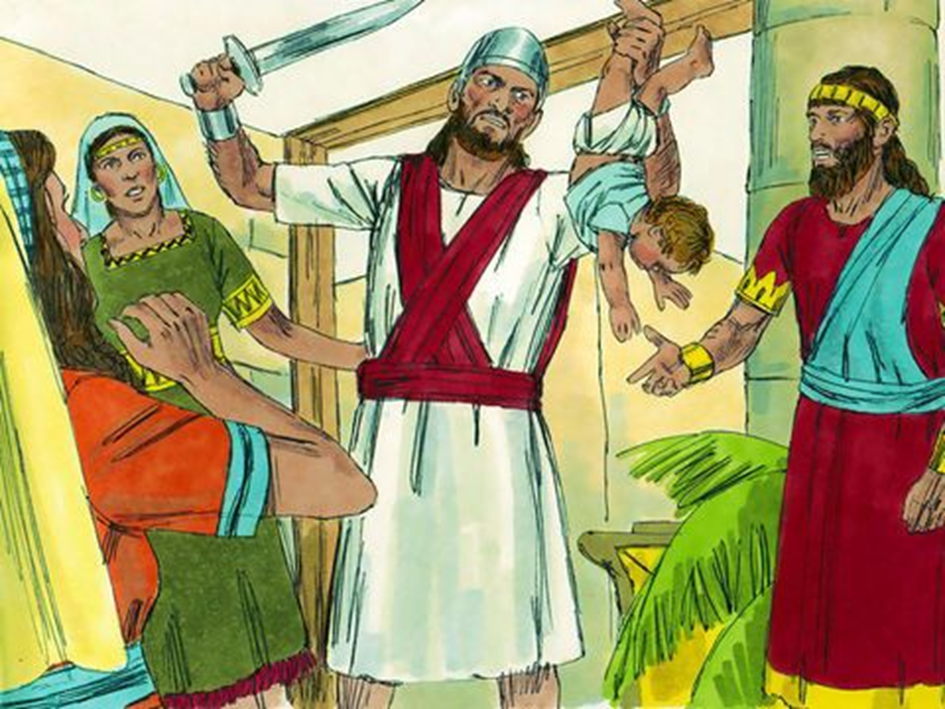
Image Source[2]
But the other woman said, „No. My son is the living one, and the dead one is yours.“ But the first insisted: „No. Your son is the dead one, and the living one is mine.“ And so they argued in front of the king. 23 The king said, „This one says, ‚My son is alive, and the dead is yours.‘ And this one says, ‚No, your son is the dead one, and the living one is mine.'“ 24 So the king said, „Give me the sword.“ So they brought a sword before the king. 25 And the king said, Cut the living child in two. Give one half to one and the other half to the other.“ 26 Then the woman whose son was alive said to the king, „Please, my lord, give her the live new-born child, but do not kill it.“ But the other said, „Let it be neither mine nor yours. Cut them open!“ 27 Then the king said, „Give the live newborn child to the one who said, ‚Do not kill him,‘ that is, his mother.“ 28 When all Israel heard of the king’s sentence, they were afraid of the king. They saw that he was endowed with the wisdom of God to execute judgment.
BUDDHIST VERSE OF THE STORY (2)
Maha-Ummagga Jataka (#546)[3]
The hungry goblin saw a mother with a child. The goblin told her mother how adorable her little boy was, and asked her to nurse him; The mother agreed. The goblin sat with the boy for a while and then ran away with him. The mother began to chase, caught the goblin, and then they both declared that the child was theirs. The bodhisattva saw the goblin’s red eyes, unblinking eyes, and lack of shadow, and he understood at once that it was not the mother, but he did not show it, and they both agreed to accept his verdict.
The bodhisattva drew a line on the ground, placed the child on it, and told each woman to grab one end and pull. Whoever gets a child behind the line, she can keep it. They began to pull, but when the baby let out a loud cry of pain, the mother let go of him and began to cry. She told the crowd that being tender with children is inherent in a mother’s heart, and revealed that the other woman was an orc who was about to eat the child. The goblin admitted her identity and intent, and the Bodhisattva rebuked her, saying that she was born as a goblin for sins from a past life and now she would not escape the path of the unrighteous because she had sinned again. He taught her the five commandments and sent her away.
BUDDHIST VERSION OF THE STORY AS A FAIRY TALLE IN INDIA (3)
Fairy tale adapted into Indian fairy tales from the Buddhist Jatakas – Bodhisatwa Tales[4]
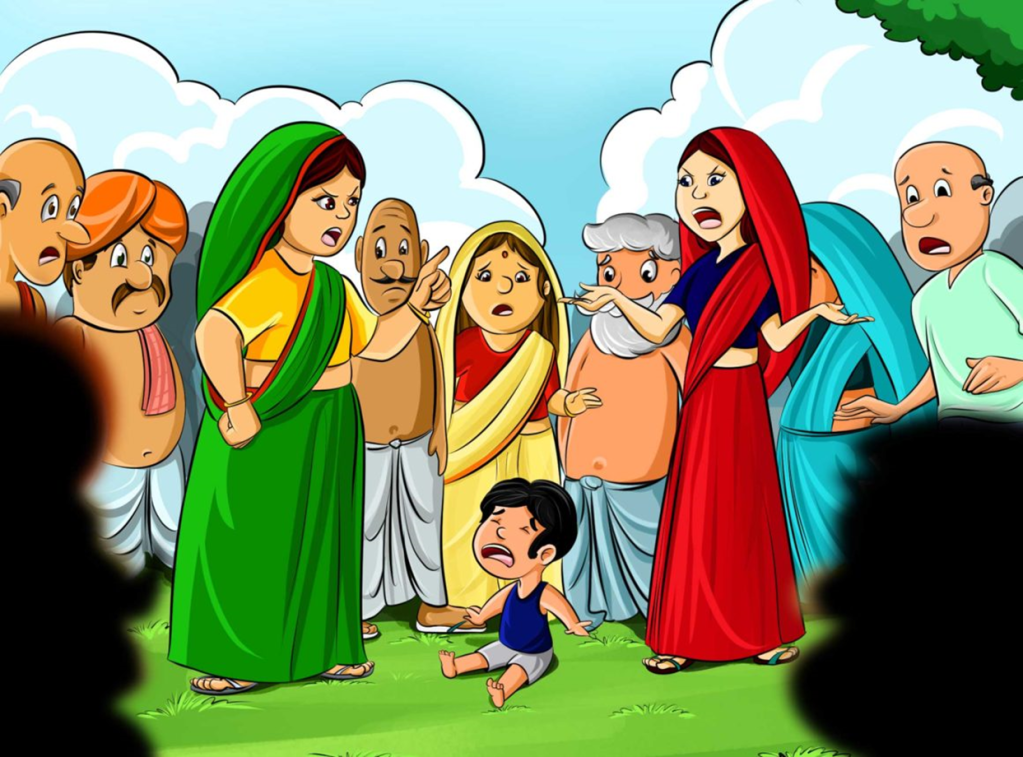
The women fought over the child. „He’s my child, leave him alone,“ cried the woman in the red sari. The poor child was too young to speak. „No, it’s mine,“ cried the woman in the green sari. Soon a crowd gathered. The village elders took the quarreling women to the wise man. The village sage asked the woman in the red sari, „What do you want to tell me?“ „He’s my child, sir. I swam in the river and left my son on the shore. This woman picked up my child and ran away. I quickly dressed and ran after her,“ the woman said. The wise man asked the other woman to explain. „She’s a liar, sir. It was me who was bathing in the river. He’s my only child. She came there, picked him up and ran away. Fortunately, I managed to catch her,“ the second woman said.The villagers who watched this drama did not know who to believe. The sage got up. Using a twig, he drew a line on the ground. He asked the two women to stand on either side of the row and placed the baby in the middle. Following the instructions of a wise man, one woman held the child by her left hand and the other by her right. „And now listen to me carefully,“ said the sage, „you both have to draw the child to you. The child belongs to the one who draws it to him.“ The woman in the red sari pulled on the child with all her might. When the baby cried in pain, the other woman let him go. „He’s mine,“ the woman in the red sari shouted triumphantly, while the other woman burst into tears. „Wait,“ said the sage, turning to the villagers, „who do you think loves a child more? The one who pulled the child to her, or the one who let him go?“ The villagers replied, „He who lets it go loves the child more.“ The sage took the child from the woman in the red sari. „Only a mother can have a tender heart for her child,“ he said. He handed the child over to the real mother, who hugged him. The baby lift received a stern warning and was allowed to go.
BERTOLT BRECHT / CAUCASIAN CHALK CIRCLE
A foreign prince with soldiers enters the city and has Governor Abasvilli killed. His wife Natela runs away and loses her young son Micheil in the turmoil of war. He is taken in by the maid Gruša, but before that she promises allegiance to the soldier Simon. Should she wait for him to return from battle, or run away from the soldiers and save the child? Seductive, terribly seductive is good. And so Gruša runs away with the child and becomes his real mother. But can it hide forever? And how will she stand up to the toughest tests that lie ahead? The story of two mothers who dispute over a child first appeared in the Old Testament – King Solomon has a sword brought and wants to „justly“ cut the child in half. A true mother prefers to step aside to save her child. Other cultures know a similar story. A chalk circle is drawn on the ground, the baby is placed in it, and the mothers tug over it.
The author of the most famous version of the legend is the famous German playwright, theoretician and director Bertolt Brecht. In his Caucasian Chalk Circle, he tells two stories – he follows the story of a kidnapped and rescued child and the fate of the outcast Azdak, who becomes an unusually peculiar judge. Both stories reach the chalk circle. Will the judge make the right decision and will the child get the right mother?[5]
[1] https://www.bibleserver.com/
[2] https://i.pinimg.com/564x/19/d8/bb/19d8bb3137e0e3866ef08fdf21c5d247.jpg
[3] Maha-Ummagga Jataka (#546) – https://thejatakatales.com/maha-ummagga-jataka-546/
[4] Source of text and image – https://kathakids.com/folktales/the-real-mother/
 GNOSTICISMUS/GNOSTICISM 2025
