Content
- Introduction – Gnosticism, Gnosis and the Question of „Elitism“
- True God vs. Demiurge – Gnostic Rebellion Against the Abrahamic Creator
- The Elitism of Gnosis – Why Knowledge Is Reserved for the Few
- Modern Gnosticism – A Revival of Gnosis and the Ongoing Struggle for Truth
- A Call to Fight for Gnosis – An Elite Effort for an Extraordinary Encounter with the Truth
- Terminology dictionary
Introduction
Gnosticism (from the Greek gnosis – knowledge) is a religious-philosophical movement that emphasizes personal spiritual knowledge beyond ordinary faith. From its beginnings in late antiquity, Gnosticism has been shrouded in an aura of secrecy—a teaching passed on only to the initiated—which has led many to believe that it is inherently „elitist.“ In this context, however, elitism does not mean social superiority, but refers to the spiritual elite, that is, to the few who attain true knowledge (gnosis) and salvation through it. The Gnostics have never been among the masses of believers; on the contrary, they considered themselves chosen ones who had penetrated to the truth hidden by the majority. Why Gnosis requires an elite approach , and why Gnosticism is fiercely opposed to the God of the Abrahamic religions, is the very essence of Gnostic philosophy. This article will discuss the Gnostic myth of the Creator (Demiurge) and the Supreme God, show why the Gnostics rejected the Abrahamic deity, and explain why Gnosis is a challenging and exclusive path. Finally, there is a call for „elitism“ in the original sense – that is, for the determined struggle of every true Gnostic for profound knowledge, culminating in an extraordinary encounter with the Truth.
The True God vs. the Demiurge: The Gnostic Rebellion Against the Abrahamic Creator
One of the central features of Gnosticism is the sharp distinction between the true supreme God and the lesser God-Creator of the material world. The Gnostics held that the God worshipped in the Abrahamic religions (i.e., the Lord Yahweh of the Old Testament) was not identical with the ultimate divine Principle. On the contrary, they considered him a subordinate and imperfect being – the Demon-Creator or Demiurge who created our material world in its imperfection. According to the Gnostics, this Demiurge (Greek Dēmiurgós – „craftsman“) is the cause of all shortcomings, mistakes and evils in the world we know. The world he created bears the marks of his limitation – „he didn’t really succeed in creating it“.
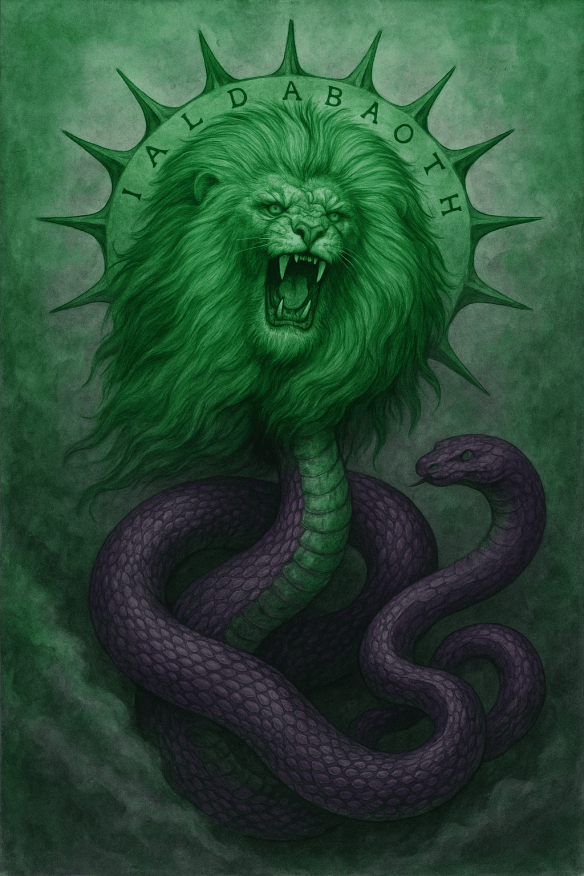
The Gnostic myth often depicts how, at the beginning of the emanations of the divine Fullness (Pleroma), a lower being – the very creative god – came into being. Some versions speak of the fall of Sophia (Divine Wisdom) and the birth of an arrogant creature named Yaldabaoth, who is unaware of his derivation from a higher Deity. This Demiurge-Yaldabaoth is identified with the biblical Lord and appears in the Gnostic texts as a proud usurper of the divine title. In the Apocryphal Apocrypha of John, the Demiurge declares: „I am God, and there is no other beside me!“ – but he says it in ignorance of the higher Power from which he himself came. From this pride-blinded statement, the Gnostics concluded that the God of the Old Testament falsely claimed to be the supreme—a false God who did not know the true, transcendent God above him. Moreover, the Gnostic interpretation of the Genesis story reverses traditional notions: whereas in the Bible the Lord forbids man to eat from the tree of knowledge, the Gnostics claim that he was preventing mankind from acquiring liberating knowledge. The Gnostic interpretation relates that the Demiurge envied man the spark of spiritual light placed in him by the transcendent God, and therefore „tried to limit man’s knowledge by forbidding him the fruit of knowledge in Paradise.“ The serpent – traditionally considered a seducer – is in the eyes of Gnosis The Gnostics thus conceived the fall of man not as the result of disobedience, but as the beginning of liberation from deception: tasting from the tree of knowledge was the first step towards Gnosis, while banning the Demiurge was an act of a tyrant who kept souls in ignorance.
To explain the persistent suffering and ignorance in the world, the Gnostics further developed the concept of the Archons (rulers). Archons are lesser gods or demonic beings who help the Demiurge to manage and control the material world – a kind of cosmic bureaucracy of his „kingdom of deception“. The Gnostics teach that humanity lives under the domination of these Archons who prevent souls from connecting with the true God. The supreme and good God is far from our world; man can only make himself known through spiritual envoys (messengers of light), such as Jesus. In many Gnostic texts, Jesus is understood not as God the Creator incarnate, but rather as a Gnostic savior sent by the true Deity to awaken the chosen souls from the power of the Archons. Gnostic Christian writings often portray him as a divine teacher of wisdom rather than a crucified redeemer; His task is to impart hidden knowledge that he will liberate. In this way, Gnostic theology departs fundamentally from Orthodox Christianity: salvation does not come through faith in the sacrifice of the cross, but through the knowledge of the truth that Jesus communicates to those who „have ears to hear.“
For the traditional Judeo-Christian faith, such claims were understandably shocking and heretical. To put the Creator of the world (the Lord) in the role of an ignorant or even evil demon was a radical inversion of religious values – a real rebellion of the spirit against the recognized order. With this harsh rejection of the Abrahamic God, Gnosticism responded to the problem of evil in the world: instead of justifying God for suffering (theodicy), it simply declared that God the creator is the author of evil because He is imperfect or malevolent. It offered the solution in the form of a higher deity of good far above the Creator. This idea also appears in some contemporaries of the early Gnostics, for example, Marcion taught in the 2nd century that the God of the Old Testament was a just but cruel demiurge, while above him there was a good God of the New Testament, the Father of Jesus. But the Gnostics went further: not only did they separate the good God from the evil Creator, but they challenged man to turn away from the false god of this world and seek the way to the unknown God of the Most High. Gnostic spirituality is at its core a revolt against the „god of this world“, whom it identifies with matter, lies and ignorance. It is this rejection of the „lord of this age“ that distinguishes the Gnostics: instead of worshipping the Creator, they focus on knowing the Transcendent, which is the source of light and salvation.
The elitism of Gnosis: Why Knowledge Is Reserved for the Few
From the above it is clear that the Gnostic way is not for everyone. Gnosis – direct spiritual knowledge – is a demanding process of awakening from the illusions of the world, which requires extraordinary powers of insight and courage to question generally accepted „truths“. The Gnostics believed that human souls were not the same: only some carried a spark of spiritual light capable of awakening to full knowledge. Therefore, already in ancient times, Gnostic schools divided people into categories according to their spiritual sensitivity. For example, Valentine’s Gnosis spoke of three types of people: hyliks (material, completely captive to matter and ignorance), psychics (mental, believing in common faith but without deeper knowledge) and tires (spiritual, gifted with divine gnosis). Only the last ones – the true Gnostics or spiritual elite – will be fully saved. It is therefore not arbitrary superiority, but a logical consequence of doctrine: only one who has attained knowledge can escape from the shackles of ignorance, while others remain bound by delusion.
Gnostic salvation is a deeply individual and esoteric matter. This means that truth cannot be given en masse or simply—it must be given covertly, gradually, and piecemeal, to those who are ready to receive it. Historical sources confirm that the Gnostic teachings had an elitist and esoteric character: the Gnostics wrote down and communicated their findings in encrypted, figurative texts that only the initiated could understand. For example, the Gnostic writings depict Jesus speaking in long discourses about the mysteries of the aeons, archons, Sophia, etc., i.e. in terms comprehensible only to a narrow circle of the learned – hence the „Gnostic“ (secretly known) character of the teaching. „Gnosticism was exclusive, elitist and esoteric, open only to a select few,“ one commentary aptly states.
But this elitism is not an expression of pride, but rather a functional necessity. The Gnostics believed that most people were unwilling or unable to accept the inconvenient truth about the world – that the world they considered to be God’s good work was in fact a prison and a forgery of an evil or misguided Demiurge. This knowledge turns everything upside down and requires the courage to think differently. It is not surprising that gnosis was often available only to a narrow circle of disciples who had undergone extensive training. The surviving accounts of the Church Fathers who criticized the Gnostics confirm that the Gnostic groups closed themselves off from outside people and considered themselves the spiritual elite within Christendom. Even the word gnostikos (gnostic) at that time referred to someone who had deeper knowledge, „a connoisseur of spiritual mysteries“. Rather than being members of one church, the Gnostics felt themselves to be a community of those who had reached a certain level of knowledge – the so-called Peace of Mind. tires or chosen ones. For example, in the text of the Apocryphon of John and others, we find that salvation is achieved by the „race of the perfect man“ or the „indestructible people“ – which are euphemisms for the community of true Gnostics, as opposed to ordinary believers outside this circle.
The emphasis on knowledge (gnosis) instead of simple faith distinguishes Gnostics from conventional religiosity. For the Gnostics, faith (pistis) is not enough – blind faith can even be an obstacle if it is placed in a false god. The personal experience of truth is key. This premise is clearly reflected in the Gnostic writings: knowledge is redemptive, while ignorance is condemnation. „In Gnosticism, the role of knowledge is emphasized at the expense of faith,“ says Aleš Chalupa when analysing Gnostic systems. In other words, a Gnostic should not simply be a believer who accepts dogmas; he is to become a seeker and bearer of direct knowledge. This necessarily distinguishes it from the majority religious society, which builds on a faith shared by all. Early Christianity sought to be universal („Catholic“ means universal) and salvation was to be available to anyone who believed. The Gnostics, on the other hand, claimed that salvation belongs only to those who have understood the mystery of existence. This essentially meritocratic concept of spirituality can be described as elitist in a positive sense – salvation is not obtained by those who submit to authority and believe, but by those who develop a higher capacity for knowledge.
It is important to emphasize that the Gnostic elite was not a social or power elite. They were often ascetic, secluded from society, sometimes persecuted. Their „exclusivity“ lay not in wealth or status, but in inner awakening. Gnostic texts sometimes use the parable of the „pearl in the mire“ – the spark of the spirit (pearl) is hidden in the mud of the material world, and only the knower recognizes and purifies it. Similarly, in the Gospel of Thomas, blessed is the „solitary and chosen soul“ who finds the Kingdom from which he came. Gnostic elitism, then, is not a closed club based on origin; it is open to anyone who undertakes the arduous journey of knowledge. However, only a few will do so – and it is precisely these who make up the spiritual elite of humanity in the concept of Gnosis.
Modern Gnosticism: The Revival of Gnosis and the Ongoing Struggle for Truth
Although classical Gnosticism was suppressed in the 3rd-5th centuries and its texts remained lost for a long time, the idea of secret liberating knowledge did not disappear completely. Over the centuries, Gnostic motifs have been found in various heretical or esoteric currents (e.g. among the Bogomils and Cathars in the Middle Ages, among mystics such as Jakub Böhme, or in various occult societies). However, it was not until the 20th century that the real boom in interest in ancient Gnosis occurred, especially after the sensational discovery of a library of Gnostic writings at Nag Hammadi in 1945. The discovery of hitherto unknown gospels and apocrypha (such as the Gospel of Thomas, the Apocrypha of John, the Gospel of Truth, etc.) has given the modern world for the first time a glimpse directly into the world of thought of the ancient Gnostics. This has led not only to academic studies, but also to a new movement of people interested in „true Christianity“ or alternative spirituality, often drawing inspiration from Gnosticism.
Modern Gnosticism can be understood in two ways: first, as the direct successor or restorer of the Gnostic churches (there are, for example, various new Gnostic communities, Ecclesia Gnostica, etc.), and second, as the more general influence of Gnostic ideas on contemporary spirituality and culture. In both directions, there is a growing emphasis on personal spiritual experience and skepticism towards established religious authorities. What we call individual spirituality today bears many analogies with Gnosis: individuals want to form their own opinions about the transcendent, often rejecting the dogmas of the churches and seeking a direct experience of divine truth. Just as in ancient times, today „some look to religion for outward manifestations of faith, and for others inner mystical experiences are more important.“ It is the second group – those focused on inner experience and knowledge – that represent a kind of modern Gnostics, even if they don’t call themselves that.
Gnostic themes have also penetrated modern pop culture and philosophy, often in surprising ways. For example, the motif of the world as a deceptive illusion controlled by hidden forces was depicted in the famous film The Matrix (1999). The researchers noticed that the architects of the Matrix – malevolent agents keeping humanity in the „hypnotic sleep“ of the collective virtual reality – are strikingly similar to the Gnostic Archons. Likewise, the main character Neo, who awakens and fights against a system of lies, can be seen as a modern Gnostic savior freeing souls from the prison of a false world. This example shows that the Gnostic idea of reality hidden behind the curtain of appearances resonates with today’s people – especially in the era of digital simulations and information manipulation. Many people feel that „something is wrong“ with the way we perceive the world and are looking for a deeper truth beneath the surface – which is the basic Gnostic impulse.
In modern times, there is also criticism of mainstream religion, which often has a Gnostic tone. For example, Pope Francis‘ description of some ecclesiastical positions as „modern Gnosticism“ (in the sense of an overly elitist spiritualism) suggests that the term Gnosticism is once again relevant, albeit sometimes misunderstood. For true modern Gnostics, however, what remains essential is what it has always done: the struggle for knowledge against ignorance supported by power structures – whether religious, political or cultural. A Gnostic of today may perceive the „Archons“ not necessarily as literal demons, but as a metaphor for the forces that enslave us: manipulative ideologies, consumer materialism, external authorities preventing independent thinking, or even the dark sides of our own psyche. However, the goal remains the same – to see through and penetrate to the true reality that liberates.
A revived interest in Gnosis is also evident in the Czech environment. There are Czech translations of Gnostic writings, books and articles on Gnosticism, and even communities professing Gnosis. For example, the Czech Gnostic Individualist Community – for whose internal use this text is intended – is one of the proofs that Gnosis lives on as a living alternative to the mainstream of spiritual life. Modern Gnostics build on the legacy of the ancients, but face new challenges of the present. One is to keep the concept of „elitism“ in its proper light – as a positive aspiration to the highest knowledge, not as arrogance. This is what the final call is aimed at.
A Call to Fight for Gnosis: An Elite Effort for an Extraordinary Encounter with the Truth
The Gnostic path is narrow and thorny, but it leads to a peak of knowledge that most do not reach – to the immediate experience of the Truth. Every true Gnostic is called to become a spiritual „elitist“ in the best sense of the word: not by putting himself above others, but by uncompromisingly striving for the Truth, even if he has to go against the tide of the whole world. The Gnostic appeal is: Wake up from the sleep of ignorance, do not be lulled by the lies of the Demiurge and his Archons! It doesn’t matter how many people around you are in a comfortable illusion – you go for the knowledge that liberates, even if you are accompanied on that journey by the solitude of the chosen.
Achieving Gnosis is neither easy nor self-evident. It is a hard struggle – a struggle with one’s own limitations, with the traps of false ideologies, with doubts and seductions of the ego. It requires discipline of mind and heart, study of esoteric truths, and deep introspection. Gnostic literature often speaks of the seeker having to go through purification and trials before he can see the Divine Light. It’s all part of the path of elite knowledge. But the reward for the effort is the highest good: an extraordinary encounter with the Truth – a direct experience of God who is above all gods. Such an encounter (gnosis) transforms the human being, for as one Gnostic saying goes, „Know thyself… you will know that you are a son of the living Father.“ Whoever experiences the Truth face to face becomes truly free and united to the Divine – he is no longer subject to the deceptions of this world.
However, this privilege does not come cheaply. It is necessary to meet it persistently and fearlessly. The modern Gnostic must be a warrior of the spirit—an elitist who accepts that truth belongs to the brave. Our time suffers from an overabundance of information, but a lack of real wisdom; A Gnostic must therefore fight his way through the chaos of information to the true knowledge of the essence of the world and himself. They also have to face the comfortable half-truths of the majority religious interpretations, which can tempt to passivity („rely on it, faith will save you“). The Gnostic challenge is the very opposite of passivity: it requires active, conscious participation in one’s own salvation. Although every person has divine potential within him, it can only be awakened by those who actively strive for it.
So let us be that spiritual elite, not out of pride, but out of vocation and determination. The world may never be full of Gnostics – Gnosis will always be a precious pearl found by a handful of seekers. Gnosticism must be elitist, because truth is not imposed on the masses; it waits for individuals who are „worthy of understanding it.“ In conclusion, we urge every reader – seeker of the Truth – to It is natural that only a few walk the path of Gnosis. But don’t forget that with every step you take up, you come closer to the community of those who really see. And when we stand at the top, in the clarity of knowledge, we will understand that the hard struggle was worth it – for we have found the Truth that frees us from all bondage.
Terminology dictionary
- Abrahamic religions / deity – religions derived from belief in the God of Abraham (one transcendent Creator): Judaism, Christianity, Islam. Gnosticism criticizes these traditional religions, especially their concept of God the Creator (Yahweh) is identified with the Demiurge.
- Archons – literally, „rulers“. In Gnostic myth, inferior gods or demonic beings rule the material world under the leadership of the Demiurge. The Archons keep man in the thrall of ignorance and delusion, preventing him from knowing the truth.
- Demiurg – literally, „craftsman“ (Greek: dēmiurgós). In Gnosticism, it is a term for a lower god the Creator of this world, identified with the God of the Old Testament. A demiurge is either evil or incompetent; He has created the material world imperfectly and is trying to prevent human souls from returning to the true God. The synonymous Gnostic term for the Demiurge is Yaltabaoth (or Saklas or Samael – „blind god“).
- Elitism – an attitude that emphasizes the exceptional role of the elite. In the context of Gnosis, it is „spiritual elitism“: the belief that true knowledge (and salvation) belongs only to a small group of initiates who have reached sufficient spiritual maturity. This is not a matter of arrogance over others, but of stating that Gnosis is a path for a select few, not a mass affair.
- Gnosis – literally, „knowledge“. Meaning knowledge of a spiritual, intuitive and saving nature – direct knowledge of God or true reality. Unlike rational knowledge or blind faith, Gnosis represents the inner experience of truth that frees the soul from ignorance. A Gnostic is one who has attained this knowledge or strives for it.
- Pleroma – literally, „fullness“. A Gnostic term for the spiritual fullness of being, the divine world of light, where the true Supreme God and divine beings (eons) reside. From the Pleromat emanations (emanations of divine powers) arise, from which the material world arises at the lowest level. The goal of Gnosis is the return of sparks of divine light from the material world back to the Pleromat (the return of souls to God).
- Sophia (Wisdom) – in Gnostic myths, the divine Aeon (being) representing Divine Wisdom. Her fall or mistake leads to the creation of the Demiurge. Sophia often stays in the Pleroma, but her lower aspect (Achamoth) becomes entangled with matter; Through its repentance and efforts to reform, the salvation of human souls is then made possible.
- The Elect (Gnostic) – a term for the saved in Gnosticism. The Gnostics also called themselves „the chosen ones“, „sons of Light“, „Seth’s seed“, etc., which distinguished them from the rest (the uninitiated). The chosen one is the one who has a divine spark within him and receives Gnosis, thanks to which he returns to God.
Note: Literature on the topic includes, for example: Kurt Rudolph: Gnosis (Academia, 2010), Hans Jonas: The Gnostic Religion and Aleš Chalupa’s study. For readers interested in primary texts, the Nag Hammad Library (published in Czech in 2007) is essential. These sources suggest that Gnosticism was not merely a historical episode, but represents a constant challenge to the search for personal Truth – a challenge that appeals to modern seekers as well.
 GNOSTICISMUS/GNOSTICISM 2025